How it works · Michigan waters
How ThirdCoastAngler scores a day
We watch river levels and water temps, check stocking, and text you when it looks good. Every water gets a score from 0 to 100. The same facts always give the same score.
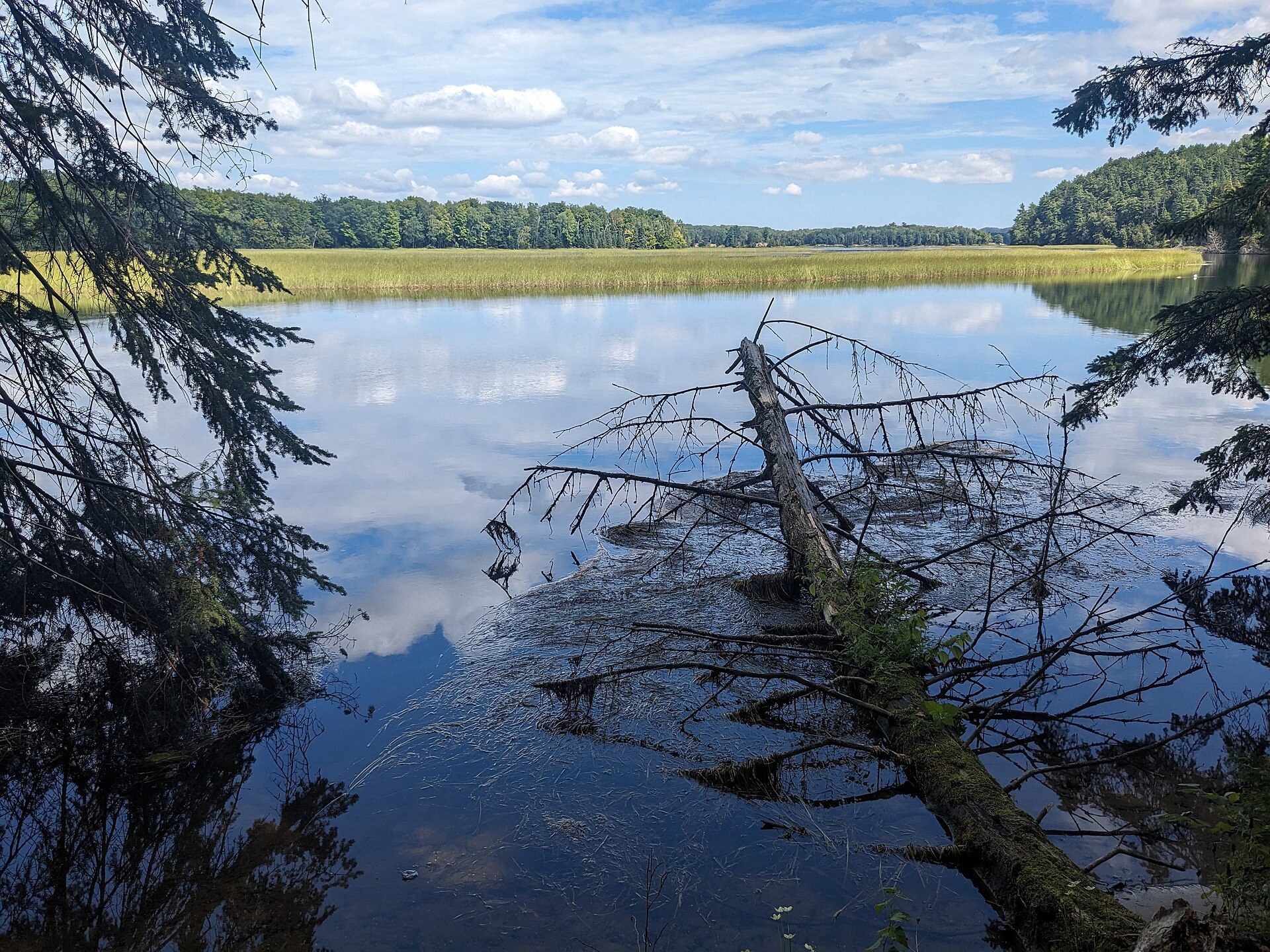
Au Sable River near Iargo Springs, Michigan · Photo: Mtn-graphic · CC BY-SA 4.0 · Cropped for display
River levels
Live river sensors
Water temp
In degrees F
Weather
Next 4 days
Stocking
Michigan DNR records
0-100
Fishing score
Good day?
You get a text
Each fish has its own sweet spot. The closer the water is to it, the higher the score.
Poor
0-44
Fair
45-64
Good
65-79
Prime
80-100
You pick how good a day has to be. Below that, Eddy stays quiet. Very high or too-warm water always keeps the score low.
For the curious
The rest of this page shows the details, sources and limits behind the score.
The score in detail
Each water gets a score from the parts that matter for your species: water temperature against that species' comfort range, river flow against that river's own history, water clarity, the forecast, and for trout, how recently the DNR recorded a stocking.
Hard limits override everything. Very high water caps the score at 20. Water too warm for the most heat-sensitive fish present caps it at 25. Rivers with no gauge that may be flooding cap at 40. When a part is missing for a species (bass, catfish, walleye and panfish are not scored on stocking), the remaining parts are re-weighted so the score still adds up to 100.
Verdicts: Prime, Good, Fair, Poor. You only get a text when a water you watch crosses your own threshold. Silence on other days is on purpose.
We also project the next four days. Those projections carry lower confidence than today.
Sources by species
- Trout: Michigan DNR stocking records (event dates, counts, strains, average length) plus USGS gauge flow and water temperature. Temperature bands follow the coldwater thresholds in our scoring tables, with heat caps for the most heat-sensitive species present.
- Bass: Lab growth optima 77-80.6F (25-27C; Niimi & Beamish 1974; Coutant 1975; Horning & Pearson 1973); bioenergetics parameters CTO 81.5F (27.5C), CTM 98.6F (37C); smallmouth cooler prime from field preferendum.
- Catfish: Channel catfish aquaculture studies - growth range 75-90F (Swann 1997); optimum growth about 85F (Wellborn 1988); best feed conversion at 81-88F cycling regimes (Arnold/Allen); feeding inconsistent below 71F, greatly reduced (Robinson & Li 2001).
- Walleye: Thermal-guild literature - prefer 64-75F, physiologically optimal (Hokanson 1977; Kitchell et al. 1977; Bozek et al. 2011); mature walleye prefer 64-72F (Christie & Regier 1988); upper lethal 81-88F (Koenst & Smith 1976); Peat et al. 2015 (adult walleye thermal ecology in Saginaw Bay).
- Panfish: Published species-guide consensus - bluegill prefer 70-80F, spawn 70-75F; crappie best 68-72F, spawn 62-72F; yellow perch cool-tolerant spring spawner (covers the 65F prime-band start).
Flow and water temperature come from USGS stream gauges. Stocking history comes from the Michigan DNR fish stocking database.
What we leave out, and why
Solunar values and the moon: left out of scoring. Quigley et al. 2023 found no trout catch-rate relationship with any solunar value.
Barometric pressure: left out of scoring. No controlled study shows it changes how fish feed.
Confidence tiers
Every score carries one of three labels, and Eddy always says which.
- Gauge-backed: flow and temperature both under 6 hours old, from a gauge on the same water or within about 15.5 miles (25 km) in the same watershed.
- Partial data: the gauge is about 15.5-46.6 miles (25-75 km) away or on a different tributary, or we have flow but no temperature.
- Weather-only estimate: no usable gauge, or all gauge data is more than 24 hours old.
Gauge data 6-24 hours old drops one tier. Older than that, it is treated as missing.
Michigan data, honestly
- Records arrive after the fact. The DNR logs stockings once they happen. We never know or announce a plant ahead of time.
- Event date vs. when we saw it. We always quote the date the fish went in, not the day the record showed up in the database.
- Fingerlings are future fish. Plants averaging about 5.9 inches (15 cm) are logged as history, not sold as fishable stockers. With no length recorded, we give the count and date only.
- Private plants never appear. Stockings by private permit or on private water are excluded before anything is shown or texted.
- Steelhead strains are named. When the record lists a strain (for example Skamania or Little Manistee), we say it.
The honest ceiling
Day-level catch models have modest explanatory power - ThirdCoastAngler is a conditions index. It tells you when the water looks right. It does not tell you whether fish will bite.
Lure and depth suggestions are a starting point - not a guarantee. When what you see on the water disagrees with the gauge, your eyes win.
Claims we never make
- Any accuracy percentage ("96% accurate") without a published, pre-registered, independently auditable test.
- "Scientifically proven," "AI predicts," or "proprietary algorithm" language for any component resting on angling heuristics or rules chosen by judgment.
- Catch prediction ("you will catch fish") - the product is a conditions index.
- Lunar/moon feeding windows for any species.
- Barometric pressure as a feeding driver - the +2 front bonus stays tied to forecast variables, never described as pressure-sensing.
- Precision beyond the inputs - no hourly stars, no exact "bite windows," no GPS-accurate feeding times.
- No ice-thickness, ice-safety, or "safe ice" statements - ever.
- For Michigan specifically: no advance stocking dates, no "catchables Thursday," no forward-looking plant claims.
Questions? quashfoundry@gmail.com - or browse the free water pages.